One longitudinal view. Across clinical care.
Every lab, every time point, on one screen. Voice navigation in English, Spanish, or Mandarin. An analytic agent for each of fifteen specialty workflows that reads the trends with you — and leaves the signature to you.
From a PDF of labs to a handoff-ready summary.
One hematology–oncology workflow, end to end: intake, timeline, voice, the Analytic Agent, handoff. Synthetic patient. Real application capture.
Amara Kim is a synthetic AML cohort case. No real patient information is shown.
Lab data lives in lists.
Patients live in trends.
A patient's history is scattered: a year of CBCs in Epic, an outside oncologist on Oracle Health, a scanned PDF from the community lab, vitals typed in at the bedside. TrendHUD compiles all of it (API, FHIR export, PDF, or direct entry), maps every value to its LOINC code, and renders one longitudinal trajectory. Correlations without the click-storm.
Correlations without the click-stormRaw results to clinical insight in three moves.
One canvas. Three waypoints. Drop the file, fly forward.
Drop a FHIR export or a PDF of results.
Epic, NextGen, InteliChart, or a scanned lab report. We extract every LOINC-coded value and show you a review step before anything is saved.
Every metric, every time point, on one canvas.
Labs aligned with the treatment timeline. Normal-range bands rendered as translucent green planes so abnormal values pop.
The Analytic Agent reads the trends with you.
Prioritized flags with dates, answers to focused questions, and a handoff summary — grounded in the patient's own trajectory.
This is TrendHUD.
An 18-month synthetic AML chart. Toggle metrics in the sidebar. Hover the timeline to crosshair every panel at once.
Or hit the blue brain in the chart header.
Real product UI. Synthetic patient (Amara Kim, AML cohort case). Every line, every band, every cycle marker is exactly what a TrendHUD physician sees.
Reads the chart the way your specialty reads it. Then shows its work.
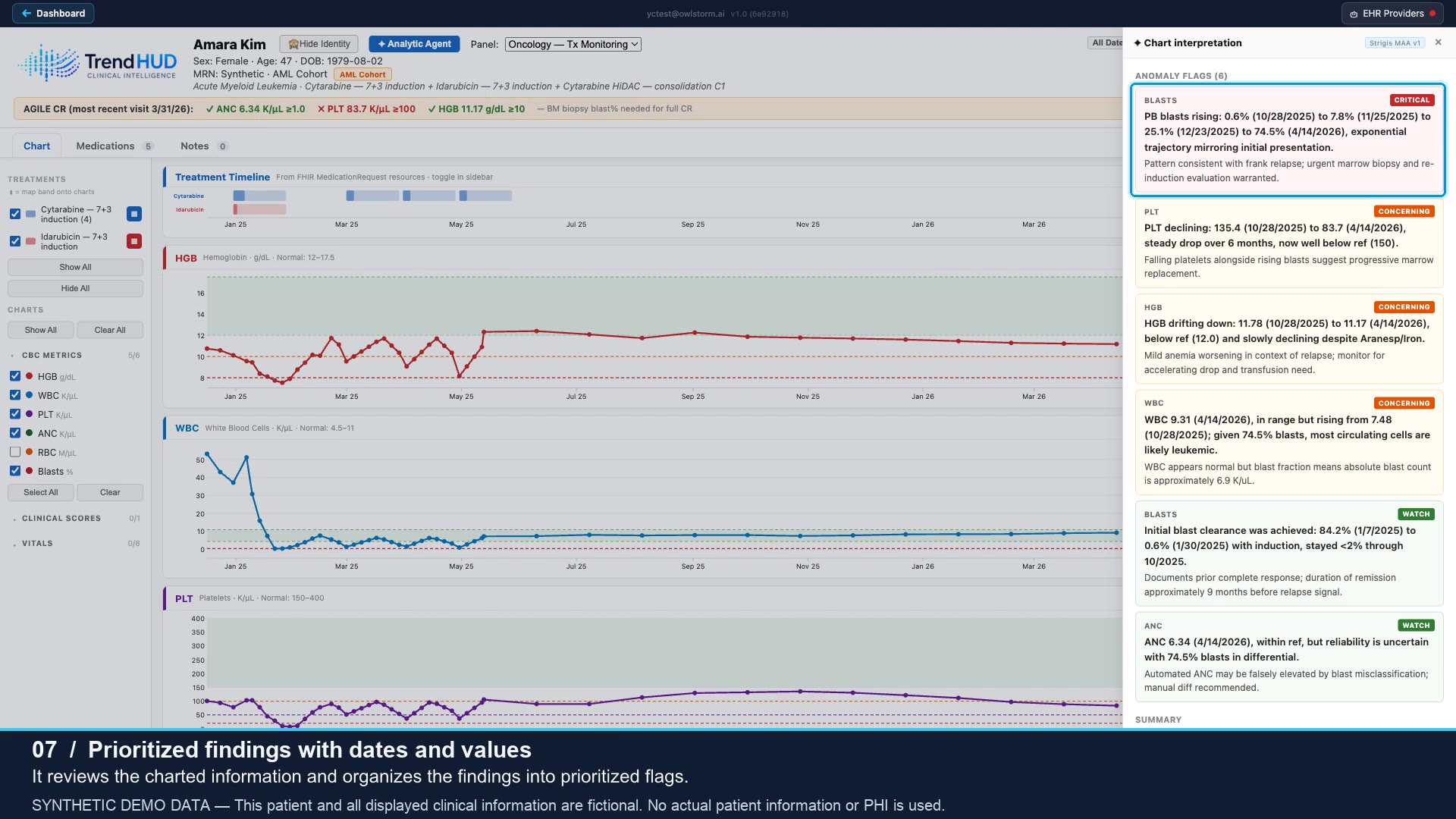
Every workflow ships with an agent tuned to its panels and protocols. Click Analytic Agent and it reviews the longitudinal record like a colleague would: findings as prioritized flags, answers to focused questions with dates and measured values, and a handoff summary — with the source chart still visible alongside.
Surfaces what matters first
Ranks abnormal trends by clinical significance, not row order — as critical, concerning, or watch. The rise in blasts before the next visit gets surfaced; the in-range RDW does not.
Cites the chart, not the cloud
Every flag carries the values and dates that triggered it. Click a citation, jump to the timepoint. Ask a focused question and the answer comes back the same way.
Speaks your protocol
Fine-tuned on AGILE, IDH-inhibitor, hypomethylating-agent, and standard 7+3 induction protocols for heme/onc — and each of the fifteen workflows gets an agent with its own panels and reference thresholds.
You stay the physician
The agent suggests. Nothing routes anywhere without your signature. Every recommendation is a draft, not a directive — copy it to a note or print it to PDF, then decide.
Next AI-modeled trajectories: a forecast of the next draw from the patient’s own history, drawn on the same chart.
PB blasts rising: 0.6% (10/28/25) to 7.8% (11/25/25) to 25.1% (12/23/25) to 74.5% (4/14/26), exponential trajectory mirroring initial presentation. Pattern consistent with frank relapse.
PLT declining: 135.4 (10/28/25) to 83.7 K/µL (4/14/26), steady drop over 6 months, now below reference. Falling platelets alongside rising blasts suggest progressive marrow replacement.
How have platelets and peripheral blasts changed since induction?
Induction drove blasts from 84.2% (1/7/25) to 0.6% (1/30/25) while platelets nadired at 7.4 K/µL and recovered to 90. Since 10/28/25 blasts have re-emerged and platelets are declining concurrently — a pattern highly concerning for relapsed or refractory disease.
Decision support. Clinical judgment is required.
Say it in your language. The chart answers.
Hands on the patient, eyes on the trend. Ask for a panel, a metric, a date range, or a treatment overlay — in English, Spanish, or Mandarin. TrendHUD transcribes the command, shows you what it heard, and moves the chart.
- 01The transcript appears before the interface responds. You always see what it heard.
- 02Commands in EN, ES, or 中文. The chart, the LOINC codes, and the agent stay the same underneath.
- 03Hide identity with one tap for teaching, tumor board, or a screen-share.
“Show me oncology treatment data.”
Transcript shown · interface executes the command
One platform. Fifteen clinical workflows.
Each workflow pre-selects the panels that specialty actually orders, ordered the way it reads — and pairs them with its own analytic agent. These are examples, not limits.
- CardiologyHeart failure · Lipids
- General practiceWhole-patient review
- OB/GYNPregnancy · Prenatal
- Diabetes managementA1c · Glucose
- UrologyPSA · Hormonal trends
- HematologyAnemia · CBC
- OncologyTreatment monitoring
- NephrologyRenal function · CKD
- HepatologyLiver function
- Thyroid / endocrineHormone trends
- Plastics / pre-opPre-op readiness
- DialysisAdequacy monitoring
- CoagulationClotting studies
- Inflammation / sepsisInflammatory markers
- Vitals monitoringBlood pressure · Weight
- + More workflowsAdditional specialties can be added
Click a workflow to pre-fill the demo request.
Built on standards your compliance team already knows.
FHIR for ingestion, LOINC for normalization, BAA on the enterprise tier. No new vocabulary. No proprietary lock-in.
FHIR-native ingestion
Reads US Core R4 Observation, DiagnosticReport, Encounter resources straight from your EHR export — or extracts them from a PDF of results.
LOINC-coded normalization
Every metric mapped to its LOINC code at ingestion. Cross-EHR comparisons stop being a chart-review project.
HIPAA roadmap · BAA on enterprise
Pilot deployments use de-identified exports. Enterprise tier ships with executed BAA and audit logging.
We're onboarding pilot practices now.
Heme/onc, endocrinology, and plastic surgery went first. Any of the fifteen workflows is open for a pilot. Tell us your panel mix and we'll get you on a call this week.